

What Using AI in Talent Actually Feels Like from the Inside
A firsthand look at how AI is reshaping talent acquisition, improving research, talent intelligence...
 Mark Melvin | Non-executive Director
February 2026
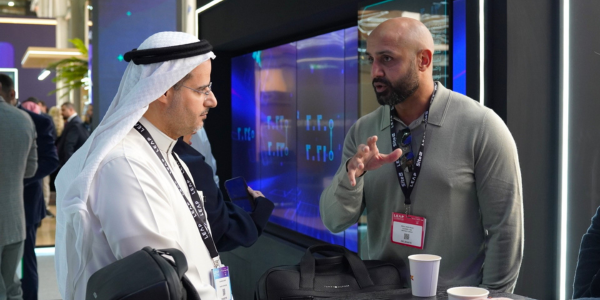
On a recent visit to the Kingdom of Saudi Arabia, conversations across government ministries and the private sector naturally turned to artificial intelligence as an immediate strategic priority shaping the country’s economic future.
Saudi Arabia has moved decisively from AI ambition to AI execution.
Vision 2030 put data and AI at the centre of economic diversification, and the Kingdom followed through with policy, investment and infrastructure at remarkable speed. Government spending on emerging technologies has grown at an estimated 59% CAGR since 2019, supported by 14 national data and AI policies, more than 245 public-sector data management offices, and world-class compute capacity. These are not theoretical assets; they are the foundations for AI at national scale.
The Crown Prince, Mohammed bin Salman, has positioned artificial intelligence as a cornerstone of Saudi Arabia’s long-term transformation strategy, not as a tool to shrink the workforce, but as a force multiplier for a nation with a relatively small population. Under his Vision 2030 agenda, the Kingdom sees AI agents and automation as a way to expand productivity, accelerate innovation, and compete with far larger economies without relying solely on population size. Rather than replacing workers, AI is framed as augmenting Saudi talent, empowering entrepreneurs, engineers, and public sector leaders to operate at global scale. In this vision, intelligent systems handle repetitive and data-heavy tasks, freeing human capital to focus on strategy, creativity, and high-value industries. For a country seeking both economic diversification and sustainable population growth, AI becomes not a substitute for people, but a strategic partner that amplifies national capability and positions Saudi Arabia as a competitive player in the digital age.
Having worked in Saudi Arabia since 2011, I’ve seen how the conversation has evolved. Early discussions focused on digital enablement. Today, the focus is firmly on AI-driven transformation with measurable outcomes. The first wave of this journey was necessarily strategy-led. Vision 2030 created demand for roadmaps, operating models and alignment to national priorities. That momentum mattered.
But many organisations are now discovering that strategy alone does not deliver value.
Across the region, most organisations report “using AI,” yet only a minority have scaled deployments or can link AI directly to material earnings or service improvements. In Saudi Arabia, the blockers are well understood: data readiness, integration complexity, and procurement models that moved too quickly from vision to solution selection.
If this sounds familiar, you’re not alone.
The question now is not “Do we have an AI strategy?” but “Can we execute it reliably at scale?”
The organisations making progress are shifting their approach:
This crawl-walk-run model is proving far more effective than launching multiple proofs of concept that never quite industrialise.
Talent is another reality check. Even with globally competitive packages, Saudi Arabia still represents a small share of global AI talent. The most successful programmes I see combine local capability-building with targeted international expertise, using mixed teams where knowledge transfer is continuous rather than contractual.
We already have strong proof points. Smart city programmes are deploying digital twins to support real-time operations and predictive maintenance. Energy and utilities players are processing billions of data points daily to reduce downtime and improve asset performance. Government platforms have delivered tens of billions of riyals in savings by embedding analytics into decision-making. In each case, the pattern is consistent: strong governance, solid data foundations, and delivery models that balance internal ownership with external experience.
What’s changed most in the last 18–24 months is expectation at the top. Ministers and executives are now asking for:
This is where data governance and procurement quietly become value accelerators rather than constraints. Clear data ownership, quality thresholds and lineage reduce friction. Procurement models that include discovery phases and bounded pilots de-risk delivery without slowing momentum.
Saudi Arabia’s AI journey is entering a more mature phase. Strategy still matters, but the centre of gravity has shifted to execution: data engineering, model lifecycle management, platform reliability and change management. AI is no longer a project to complete; it is a capability to institutionalise.
The economic upside is significant. AI could contribute over $135 billion to Saudi Arabia’s GDP by 2030. With infrastructure, policy and talent pipelines in place, this is now an execution challenge, not an aspiration.
I’m curious to hear from leaders across KSA:
If we want AI to deliver lasting value in Saudi Arabia, the next chapter will be written less in slide decks and more in production systems, operating models and capable teams.
Ready to move from AI vision to value? Speak with one of our experts.