

Stress Resilience for Leaders: Takeaways from the First Workplace Wellness Assembly
Leadership resilience insights from the first Workplace Wellness Assembly: stress, wellbeing, AI,...
Jul 14, 2026, 1:37:19 PM
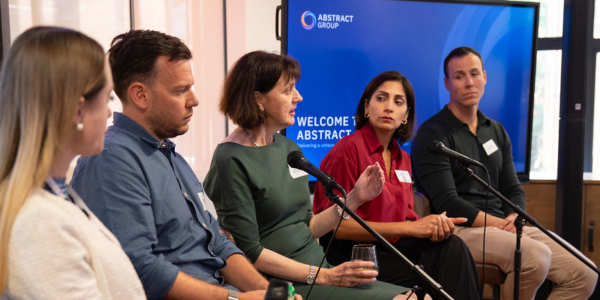
Leading an organisation right now means carrying a lot at once, and carrying most of it alone. AI transformation, a board's scrutiny, a workforce under strain, and an economy braced for recession: the pressures are numerous, they compound, and they are felt most heavily at the top. What the people running things rarely get is a room of peers in which to be honest about it.
That is why we created the Workplace Wellness Assembly: a curated gathering of senior leaders from across Leeds and the North, brought together to share what is actually working and to leave with something they can put to use, for their teams and for themselves. The first Assembly was held on the 2nd of June 2026 at Abstract Group's Leeds HQ, on the theme Stress Resilience: From Mindfulness to Management.
After welcome drinks, we kicked off the evening by introducing the question the Assembly was built to answer 'how do you build a high-performing organisation without burning out the people leading it, yourself included?'
Each of the four panellists then gave a short talk and put one live question to the room. After a break over charcuterie, organic wines and gut-healthy drinks, we reconvened and opened the floor for the panellist Q&A. Each person on our panel was chosen for a different vantage point, on the principle that stress resilience belongs to no single function: a Head of cloud and consultancy partner, a financial markets non-executive director, a global talent lead, and a fitness executive. Each operating at some of the largest and most demanding organisations in the world, where simply reaching those positions is a testament to their own ability to keep performing under the kind of sustained pressure the evening set out to explore.
Jonathan Grice on why resilience is a mental health and organisational problem
Jonathan Grice is a partner and head of cloud at KPMG, where he leads cloud and engineering practices across five countries and more than 640 people. Much of his work sits between the boardroom and the engineers building the technology, two groups that often want very different things. Boards ask why the business isn't moving faster on AI; the engineers ask how they are meant to keep up the pace with the capacity they have, and no amount of deep breathing can properly deal with this. The stress, he argued, pools in the gap, driven by pace without clarity, poor prioritisation, too little control over time, accountability asymmetry, and an organisation that never settles into a steady state, all of which make stressful situations harder to manage stress.
Jonathan put one question to the room: "If you're honest, where does most stress in your role actually come from?"
In the second quarter of 2025, the Conference Board's quarterly gauge of US chief executive confidence found 83% braced for a recession; in PwC's 29th annual global survey of more than 4,400 chief executives, published in January, 42% named keeping pace with AI as the concern worrying them most.
There is no shortage of external forces with a claim on a leader's attention, but in the room. barely a quarter pointed to outside pressure as the source of most of their stress at all, and the single biggest source they named was their own expectations and standards. The stress that weighs heaviest is the stress they put on themselves.
It is the kind of counter-intuitive result we go into in more depth in our [the white paper] from the evening, which gathers the full poll data, the research behind it, and a profile of each panellist. Resilience, on that evidence, is built or lost by design.
Key takeaways from Jonathan Grice:
"Are we building organisations that enable successful teams, or hiring superhuman people just to keep up with the change?" - Jonathan Grice, KPMG
Sally Macdonald on building resilience by design
Sally Macdonald has more than forty years in financial markets, over thirty as an Asian fund manager. She is senior independent director and non-executive director at JPMorgan Japanese Investment Trust, Fidelity Asian Values plc, Allianz Global Investors UK and across the Thesis Holdings group. Her case was the most unsentimental of the night: resilience is something you design, and it starts with the boardroom risk register.
Sally put a question of her own to the room: "What is at the top of your risk register?"
Markets took the largest single share, as you would expect them to. But taken together, the people risks, the loss of key staff, sickness, stress-related illness and right-sizing, outweighed them. It is a telling result. Most formal risk registers still rank economic and cyber threats at the top and push talent well down the list, yet the room had landed somewhere more astute: an instinct that an organisation is undone less often by the market moving against it than by losing the people it depends on to respond.
Key takeaways from Sally Macdonald:
"Work out your most likely risks, do something about them, then put it in a drawer and sleep well, because you will have earned it." - Sally Macdonald, Non Executive Director
Jasmine Gill on personal resilience: the driver most leaders miss
Jasmine Gill is digital talent manager at Coca-Cola Europacific Partners, Coca-Cola's largest bottler, operating across 31 markets with 42,000 colleagues. Her career, from factory-floor production teams to global talent, gave her a reading that cut against the easy assumption. We blame workload; Jasmine's experience points to uncertainty. Stress climbs just as sharply when people cannot see where their career is heading, at local, market and global level alike.
The question she put to the room came at the same idea: "What creates the most pressure for your people during periods of change?"
Workload is the intuitive answer, and it took the largest single share. But it is not where the change research lands. Prosci, a change-management research firm whose benchmarking draws on thousands of organisational change programmes, finds the leading source of resistance is not the volume of work but a lack of awareness of why the change is happening at all. The room read it the same way: once grouped, uncertainty about what comes next and a lack of clarity on priorities together ran well ahead of workload. Which is exactly Jasmine's point, and clearer progression paired with small, achievable goals can make change feel more manageable.
"Stress doesn't only come from workload. It comes from uncertainty, from not being able to see your own progression." - Jasmine Gill, Coca-Cola Europacific Partners
Key takeaways from Jasmine Gill:
Sean Murphy on the gap between knowing and doing to manage stress
Sean Murphy is chief personal training officer at Ultimate Performance, the event's partner, where fourteen years took him from the gym floor to the executive team. His argument was the most counter-intuitive of the evening: the problem is not that leaders don't know what to do, it's that building resilience takes practice and does not happen overnight. The executives he trains manage their own health the way a poor manager handles a failing project, throwing more at it when the answer is to simplify. He knows the failure from the inside, having watched his own routine collapse when he joined the executive team.
His question to the room: "Compared to 12 months ago, is your physical health better, the same, or worse?"
The overwhelming majority said their health had held or improved over the year, with only a small minority reporting worse. Wherever you are now, he said, is roughly where you will be in a year unless you change something.
"One of the most impactful things you can do for your team's wellbeing is take your own health seriously, because it empowers everyone else to do the same." - Sean Murphy, Ultimate Performance
Key takeaways from Sean Murphy:
After the talks, the floor opened up to the assembly attendees. A few exchanges stood out:
We are already planning the next Assemblies. They will run through the rest of 2026 and into 2027, each built around a distinct leadership and wellbeing theme, from psychological safety at executive level to the cognitive load AI places on senior teams.
The figures here are only the headlines. The white paper has the rest: the full poll data, the research behind it, a profile of every panellist, and practical tips, tools, and resources leaders can use to build their own resilience, rather than trying to find ways to recover once it’s already been lost.
Workplace Wellness Assembly White paper
The economic case alone is hard to ignore. A workforce wellbeing crisis costs UK employers around £51 billion a year, and every £1 invested in workplace mental health returns an average of £4.70, both from Deloitte's UK research on mental health and employers.
If you would like to be among the first to hear about the next Assembly, [register your interest here]. Future events will also connect leaders with relevant community support and wellbeing services. And if you lead in an area this conversation should hear from, we would like to hear from you: [submit your interest to speak at a future event here].
What is the Workplace Wellness Assembly? The Workplace Wellness Assembly is a curated peer conversation series hosted by Abstract Group in Leeds and across the North. It brings senior leaders together with wellness and resilience professionals to work through the pressures of running an organisation, with each leader learning from a different professional vantage point, helping leaders build resiliency and overcome life's challenges.
When and where was the first Workplace Wellness Assembly held? The first Workplace Wellness Assembly took place on the 2nd of June 2026 at Abstract Group's headquarters in Leeds, on the theme Stress Resilience: From Mindfulness to Management.
Who spoke at the first Workplace Wellness Assembly? The evening opened with a panel featuring Jonathan Grice, partner and head of cloud at KPMG; Sally Macdonald, senior independent and non-executive director at JPMorgan Japanese Investment Trust and other investment boards; Jasmine Gill, digital talent manager at Coca-Cola Europacific Partners; and Sean Murphy, chief personal training officer at Ultimate Performance.
What was the standout finding from the event? Asked where the stress in their role comes from, leaders pointed at themselves rather than outward. Their own expectations and standards were the single biggest source named, ahead of external pressure, the board or the competition. The published research would have predicted the opposite. In the second quarter of 2025, the Conference Board's quarterly gauge of US chief executive confidence found 83% braced for recession, and PwC's 29th annual global survey of chief executives, published in January, found 42% naming the effort to keep pace with AI as their foremost concern. The room set those external forces aside and pointed instead to the standards they hold themselves to. That also reinforced a broader point: worry is a normal part of leadership life, and resilience is more about how people respond, reflect, and bounce back than about avoiding pressure entirely. As one example, self-awareness can help leaders identify what they find easier to handle, where support from friends or family makes a difference, and which pressures call for a different response.